
Dates-LE
Extract every date and timestamp, and the exact instant each one resolves to
No editor in the loop? npx -y dates-le-mcp runs the same engine as an MCP server, so an agent can call extract_dates with nothing else installed, and cargo install dates-le puts the same check in a terminal. Every way to install it.
What Dates-LE does
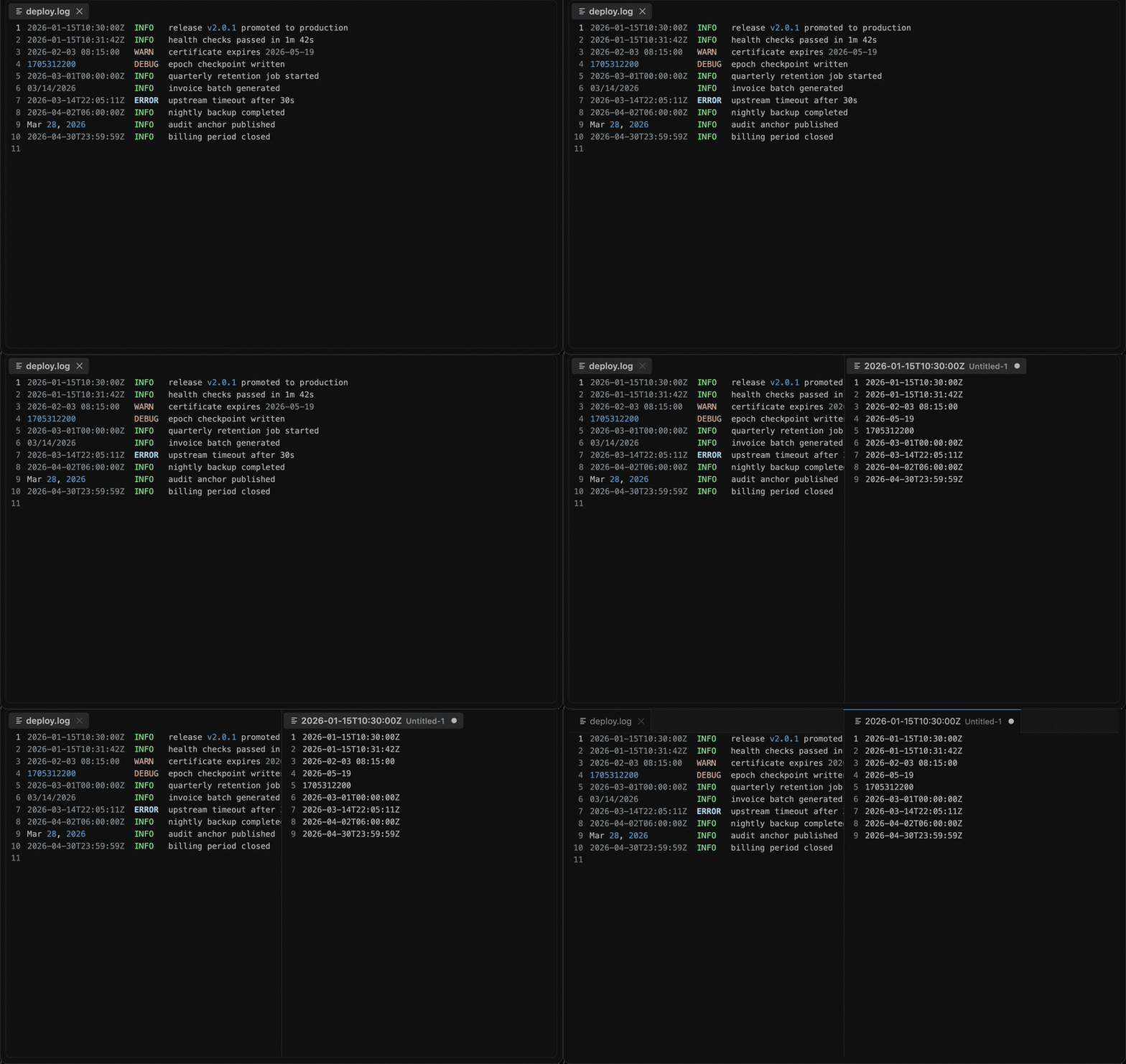
Timestamps arrive in a dozen notations and rarely the one you want. Dates-LE extracts every date and time value from logs, data files and code, reporting each with its format and, where resolvable, its epoch value. It recognises ISO 8601, syslog and Apache access-log formats, common regional notations and Unix timestamps.
What people use it for
Log analysis
Timestamps from server logs — ISO, syslog and Apache access-log formats.
Data review
Dates and epochs from JSON, YAML, CSV and XML.
Code audit
Date literals and the arguments to new Date(), Date.parse(), moment(), dayjs() and DateTime.fromISO().
9 commands in the palette
Open the command palette and type the name. Nothing is bound to a shortcut by default — the editor's keymap is the user's, not ours.
dates-le.extractDatesdates-le.postProcess.dedupedates-le.postProcess.sortdates-le.openSettingsdates-le.analyzedates-le.convertdates-le.filterdates-le.validatedates-le.helpInstall Dates-LE
VS Code
ext install nolindnaidoo.dates-leOpen Quick Open (Cmd/Ctrl+P) and paste.
Cursor / VSCodium
cursor --install-extension OffensiveEdge.dates-leVS Code forks pull from Open VSX, where the namespace is OffensiveEdge.
ZedComing soon
npx -y dates-le-mcpWorks in Zed today — add the command above as a custom MCP server from the agent panel, and extract_dates appears in its tool list. The one-click listing in Zed's extension registry is a pull request awaiting review. Track the review.
AI agents
npx -y dates-le-mcpRuns Dates-LE's engine as an MCP server, so an agent can call extract_dates with no editor involved. VS Code 1.101+ needs nothing — the extension registers it for you.
Where it ships
One engine, 6 places to get it. The ids differ by registry — copy the one for the editor you use.
Zed
built from Rust in the tool repodates-leOpenlisting pending — this links to the open pull request
Where Dates-LE lives
- VS Code Marketplacedates-le
- Open VSXfor Cursor and VSCodium
- npmdates-le-mcp
- GitHubsource, issues, changelog
- MCP registryio.github.nolindnaidoo/dates-le
The other 15

Extract every string in a codebase, with its position, so a person can read them

Extract every hardcoded number in a codebase, so a person can check them

Extract every file path in a codebase, and say whether it still points at anything

Extract every color in a codebase, and say which ones are not in your palette

Extract every URL in a codebase, with its protocol and exact position

Extract every quantity with its unit, normalized, and refuse the ambiguous ones by name

Extract every UUID, ULID, NanoID, ObjectId and Snowflake, and decode the time inside

Extract every IP address, CIDR block and MAC, normalized and classified by scope

Find every regex in a codebase, and report which can be driven into catastrophic backtracking

Check whether a page is scrapeable before the scraper is written, and say when it cannot tell

Find where one dependency is constrained differently across a repository's manifests

Identify the i18n library a project uses, then audit its catalogs by that library's rules

Find hardcoded credentials in a codebase, and never print one into the report

Compare the dotenv files in a tree, and say which keys are missing from which

Find the Unicode that hides meaning — bidi controls, invisibles, homoglyphs, mixed scripts